
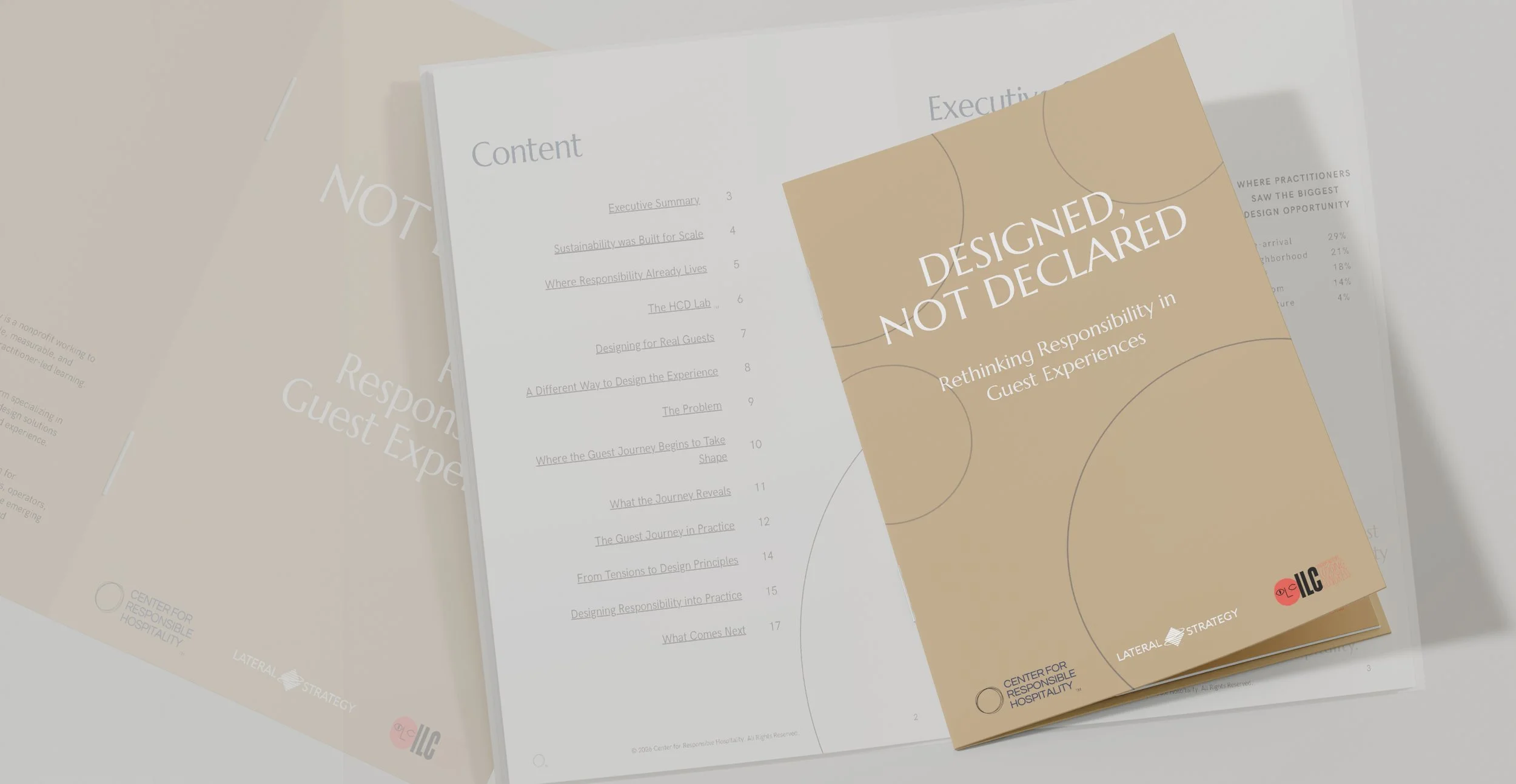
Designed, Not Declared: Rethinking Responsibility in Guest Experiences
Most hotels tell guests they're responsible. Few have designed it that way.
Designed, Not Declared is a research report from the Center for Responsible Hospitality that examines where responsibility actually shows up in the guest experience — and where it breaks down. Drawing on a first-of-its-kind Human-Centered Design Lab held at the Independent Lodging Congress Confab in San Juan, the report brings together 40 independent hotel owners, operators, and designers to map what responsible hospitality looks like when it's built into the experience rather than declared through signage, certifications, or guest asks.
The findings challenge where the industry focuses its attention. Nearly a third of practitioner ideas concentrated on the pre-arrival moment — where expectations are set and defaults are established — while the in-room experience, where most traditional sustainability programs live, drew just 14%. Departure, one of the most promising moments to extend a guest's relationship to place, remains almost entirely undesigned.
The report identifies three tensions that explain why so many responsible hospitality efforts fall flat: the compliance trap, the communication paradox, and the authenticity-scale paradox. From these, five design principles emerge: Defaults Over Asks, Stories Over Certifications, Restraint Over Declaration, Curation Over Access, and Evidence Over Optics.
The result is a practical framework for independent hotels — and the broader industry — to stop performing responsibility and start designing it.
To download the report, complete the form below.